

Introduction
Imagine a time in your career when you don't have to save any more money for retirement, because the money you've invested will be able to grow to become a complete retirement savings account at the age of 65. This is the goal of Coast FIRE and a calculator for coast fire is the tool that will tell the exact time you'll get there.
For those who are a salaried professional or a member of a household with two incomes or just who is tired of figuring out if the numbers are “on track,” this guide explains the meaning of what Coast FIRE is and how you can calculate your numbers and how to make use of a calculator when planning your next step. In the end you'll know exactly the amount you'll need to spend now to sail to the end of the road towards financial freedom.
What Is Coast FIRE?
Coast FIRE is a type of financial independent strategy that lets you make savings and invest heavily as you begin your career, until you have reached a certain dollar value - the Coast FIRE amount. Once you've reached that number that is reached, compound interest will do the heavy lifting and you do not need to put more money into retirement.
After reaching Coast FIRE, you can:
- Switch to a lower-paying but more fulfilling job
- Reduce your work hours
- Cover only your current living expenses without additional retirement savings
- Still retire comfortably by traditional retirement age
This differs from a full FIRE (Financial Independence, Retire Early) in which you stop working completely. Coast FIRE simply removes the obligation to save and gives you more flexibility in the way you work.
Benefits of Coast FIRE
Coast FIRE isn't just a savings milestone - it's a shift in how you relate to work and money. Here's why so many professionals are working toward it.
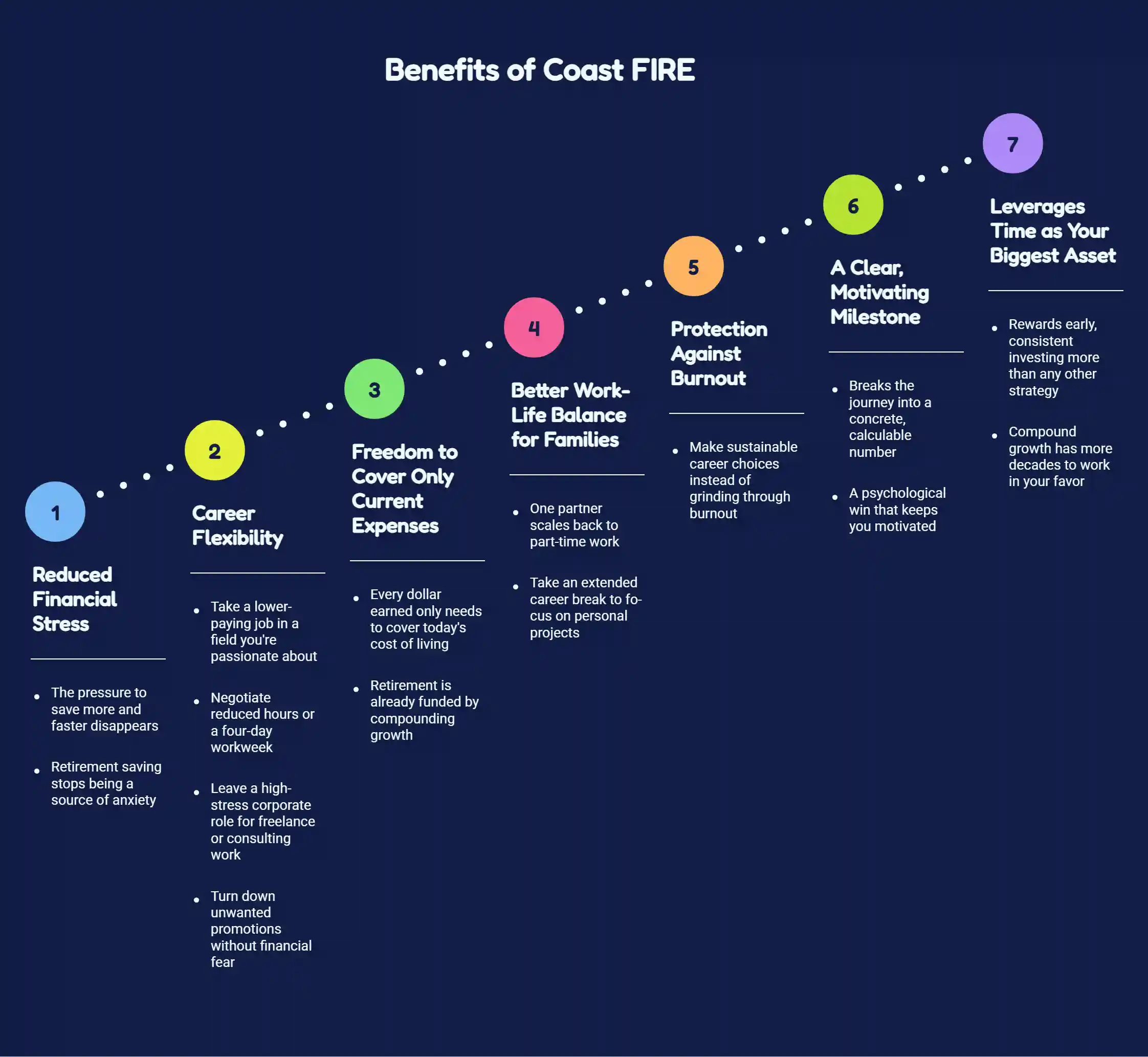
1. Reduced Financial Stress
Once your invested assets are projected to grow into your full retirement number on their own, the pressure to “save more, save faster” disappears. You still work and earn, but retirement saving stops being a source of anxiety.
2. Career Flexibility
Reaching Coast FIRE opens doors that a strict paycheck-to-paycheck mindset closes:
- Take a lower-paying job in a field you're passionate about
- Negotiate reduced hours or a four-day workweek
- Leave a high-stress corporate role for freelance or consulting work
- Turn down unwanted promotions without financial fear
3. Freedom to Cover Only Current Expenses
After hitting your number, every dollar you earn only needs to cover today's cost of living - housing, food, insurance, discretionary spending - since retirement is already funded by compounding growth. This alone can meaningfully lower the income you need to feel secure.
4. Better Work-Life Balance for Families
For dual-income households, Coast FIRE can mean one partner scales back to part-time work or takes an extended career break to focus on children, caregiving, or personal projects, without derailing the family's long-term retirement plan.
5. Protection Against Burnout
Knowing your retirement is essentially “locked in” gives you permission to make sustainable career choices instead of grinding through burnout for a paycheck you don't strictly need anymore.
6. A Clear, Motivating Milestone
Traditional retirement planning can feel abstract and decades away. Coast FIRE breaks the journey into a concrete, calculable number you can track and celebrate - a psychological win that keeps you motivated to keep investing early.
7. Leverages Time as Your Biggest Asset
Coast FIRE rewards early, consistent investing more than any other strategy. The earlier you start, the smaller your required Coast FIRE number, because compound growth has more decades to work in your favor.
What Is a Coast Fire Calculator?
A coast fire calculator is an online tool that estimates how much money you need to invest today so that, left untouched, it grows into your full retirement number by a target age. It factors in your:
- Current age
- Target retirement age
- Current invested savings
- Expected annual investment return
- Desired annual retirement spending (or a target retirement portfolio size)
Rather than manually running compound interest formulas, a fire coast calculator does the math instantly, giving you a clear, personalized target.
How to Calculate Coast FIRE Number
Understanding how to calculate coast fire manually helps you trust - and double-check - any calculator's output. Here's the formula used behind the scenes:
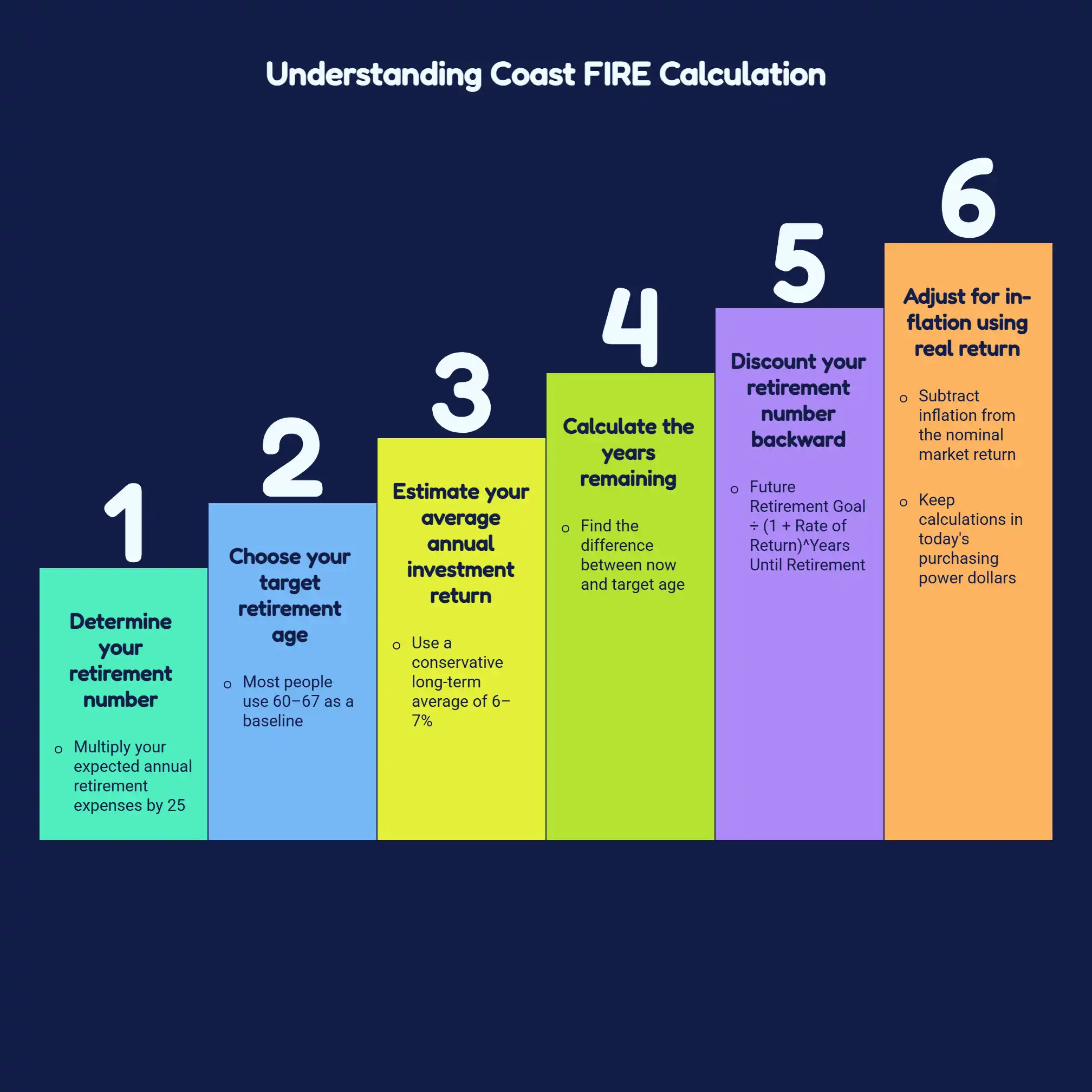
Coast FIRE Number = Future Retirement Goal ÷ (1 + Rate of Return)^Years Until RetirementStep-by-Step Breakdown
- Determine your retirement number. A common approach is the 25x rule: multiply your expected annual retirement expenses by 25 (based on a 4% safe withdrawal rate).
- Choose your target retirement age. Most people use 60–67.
- Estimate your average annual investment return. A conservative long-term average is 6–7% after inflation.
- Calculate the years remaining between now and your target retirement age.
- Discount your retirement number backward using the formula above.
Example: How to Calculate Coast Fire Number
| Variable | Value |
|---|---|
| Annual retirement expenses | $60,000 |
| Retirement number (25x) | $1,500,000 |
| Current age | 30 |
| Retirement age | 65 |
| Years to grow | 35 |
| Assumed return | 7% |
Coast FIRE Number = $1,500,000 ÷ (1.07)^35 ≈ $138,300
This means that once this person has $138,300 invested, they don't technically need to add another dollar to reach $1.5 million by age 65 - assuming a steady 7% average annual return.
Nominal Return vs. Real (Inflation-Adjusted) Return
Here's where a lot of DIY calculations go wrong: which return rate should you actually plug in?
- Nominal return is the raw, unadjusted average market return - historically around 10% for the S&P 500.
- Real return subtracts inflation from that nominal figure, giving you growth measured in today's purchasing power.
Real Return = [(1 + Nominal Return) ÷ (1 + Inflation Rate)] − 1Using a 10% nominal return and 3% average inflation:
Real Return = (1.10 ÷ 1.03) − 1 ≈ 6.8%
Using the real return instead of the nominal return keeps your entire calculation in “today's dollars” - so your $60,000 annual spending target doesn't need a separate inflation adjustment later. This is the same approach used by most reputable coast fire calculators, and it's the single most important adjustment that separates an accurate projection from an overly optimistic one.
Full Worked Example Using Real Return
| Variable | Value |
|---|---|
| Annual retirement expenses (today's dollars) | $60,000 |
| Safe withdrawal rate | 4% |
| Retirement number | $60,000 ÷ 4% = $1,500,000 |
| Current age | 35 |
| Retirement age | 65 |
| Years to grow | 30 |
| Nominal return | 10% |
| Inflation rate | 3% |
| Real return | 6.8% |
Coast FIRE Number = $1,500,000 ÷ (1.068)^30 ≈ $228,900
At 35, having $228,900 already invested - with no further contributions - would be projected to grow into a $1.5 million retirement portfolio (in today's dollars) by age 65.
Where Did the Term “Coast FIRE” Come From?
The broader FIRE movement traces back to the 1992 personal finance classic Your Money or Your Life by Vicki Robin and Joe Dominguez, which first popularized the idea of aligning spending with life energy and working toward financial independence. The underlying concept behind Coast FIRE started appearing on FIRE forums and blogs in the 2000s under related names like Barista FIRE and RV FIRE, before the specific term “Coast FIRE” emerged.
The term itself is widely credited to a 2016 ChooseFI podcast episode featuring Sam Dogen (founder of Financial Samurai), though its exact origin isn't definitively documented - most sources describe it as the term appearing to come from that episode rather than confirming it as the first recorded use. What is clear is that usage of “Coast FIRE” (and “coastFI”) has grown substantially since then, particularly as more calculators and content were built around it starting in the late 2010s.
You may also see the term written as “coastFI” - the two are used interchangeably. “FI” refers to Financial Independence broadly, while “FIRE” adds the “Retire Early” component. Since Coast FIRE isn't about retiring early in the traditional sense (you keep working, just without saving pressure), some purists consider “coastFI” the technically correct term. For search and everyday use, both terms mean the same thing.
Coast Fire Calculator for Couples
Dual-income households have a unique advantage: two incomes contributing to one shared goal. A coast fire calculator for couples typically adjusts the formula by combining:
- Both partners' current invested assets
- Combined annual retirement spending target
- A shared or averaged retirement age
- Each partner's individual investment accounts (401(k), IRA, brokerage)
Tips for Couples Using a Coast Fire Calculator
- Combine your numbers carefully. Add both partners' invested balances, not household net worth (exclude home equity and cash reserves).
- Account for age gaps. If one partner is older, calculate the number based on the later retirement date for accuracy.
- Factor in future income changes. Career breaks, parental leave, or a shift to part-time work can affect your timeline.
- Recalculate annually. Life changes - salary increases, new expenses, market performance - should be revisited each year.
How to Use a Coast Fire Calculator (Step-by-Step)
Using the best coast fire calculator for your situation is simple once you understand the inputs:
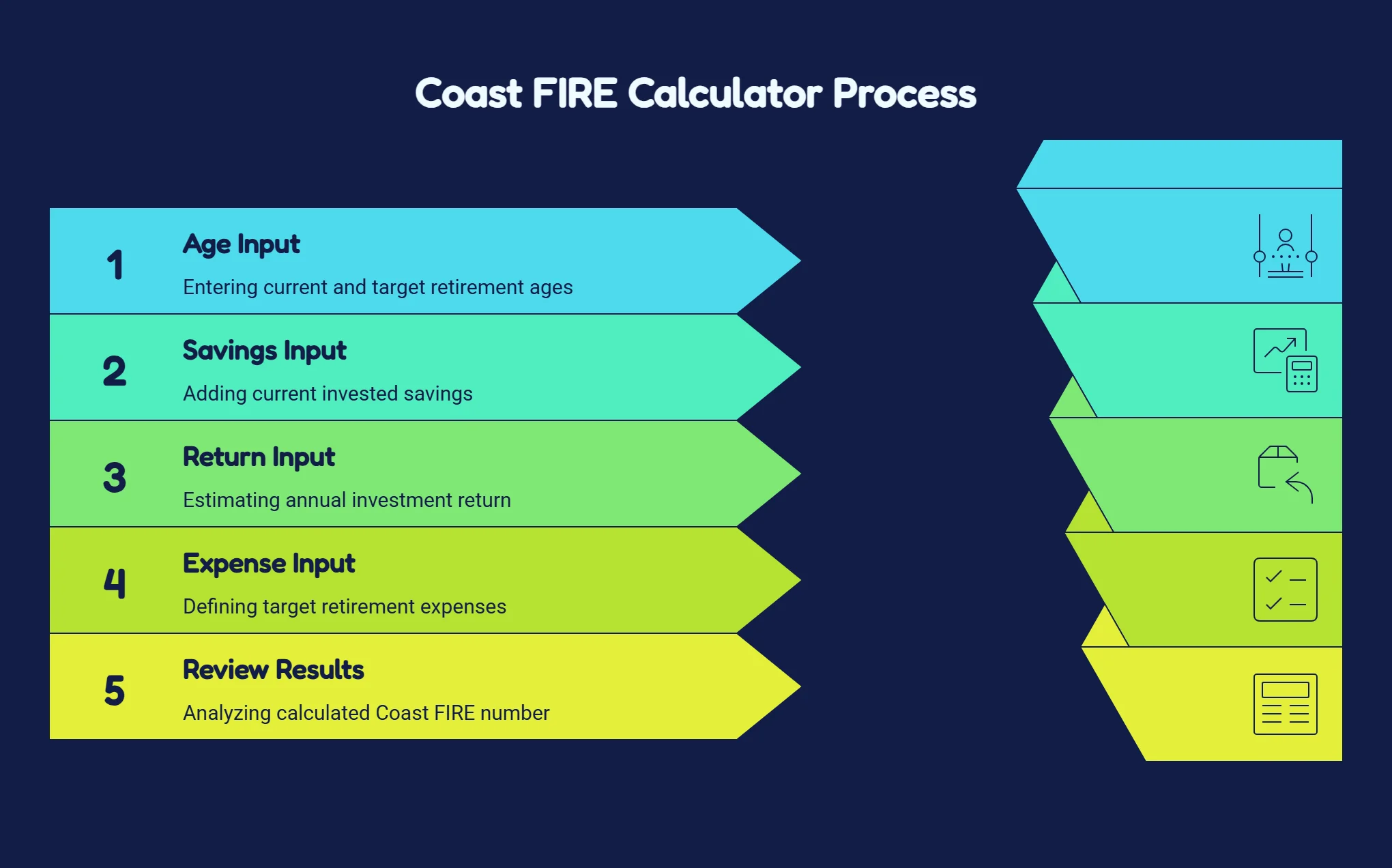
- Enter your current age and target retirement age.
- Input your current invested savings (retirement + brokerage accounts).
- Add your expected annual return - 6–7% is a widely used, realistic estimate for a diversified portfolio.
- Enter your target retirement expenses or portfolio goal.
- Review your results: most calculators show your Coast FIRE number, how close you already are, and your projected “coast date.”
Many tools also let you toggle between:
- Standard Coast FIRE (stop retirement saving entirely)
- Barista FIRE (continue part-time work to cover current expenses)
- Coast FIRE with continued small contributions
Why Use a Coast Fire Retirement Calculator Instead of Manual Math?
While the formula is straightforward, a coast fire retirement calculator offers real advantages:
- Speed: Get results in seconds instead of running multiple formulas.
- Scenario testing: Instantly compare different retirement ages, return rates, or expense levels.
- Visualization: Many calculators show growth charts, making it easier to see how your money compounds over decades.
- Accuracy: Reduces the risk of manual calculation errors, especially with compound interest.
- Couples and household planning: Combine multiple accounts and incomes without complex spreadsheets.
Key Factors That Affect Your Coast Fire Number
| Factor | Impact on Coast FIRE Number |
|---|---|
| Higher expected return | Lowers the number needed today |
| Longer time horizon | Lowers the number needed today |
| Higher retirement spending goal | Raises the number needed |
| Earlier target retirement age | Raises the number needed |
| Inflation assumptions | Higher inflation raises the effective number |
Understanding these variables helps you interpret calculator results rather than treating them as fixed, guaranteed outcomes.
Common Mistakes to Avoid
- Using an unrealistic return rate. Overly optimistic assumptions (10%+ without adjusting for inflation) can create a false sense of security.
- Ignoring inflation. Always use “real” (inflation-adjusted) return rates for long-term accuracy.
- Forgetting healthcare and taxes. Retirement expense estimates should include these often-overlooked costs.
- Treating the number as static. Recalculate at least once a year or after major life changes.
- Overlooking sequence-of-returns risk. Market downturns early in your coast period can extend your timeline.
Risks and Drawbacks to Weigh Honestly
Coast FIRE is a powerful strategy, but it isn't risk-free. Before committing to it, consider:
- Front-loaded sacrifice. Reaching your Coast FIRE number requires saving aggressively in your 20s and 30s - often while peers are spending more freely on lifestyle upgrades.
- Market underperformance. Coast FIRE math relies on historical average returns. A prolonged bear market or lower-than-expected long-term returns could push your actual coast date later than projected.
- Life changes. Marriage, children, relocation, health issues, or a career interruption can all shift your expenses and timeline in ways a static calculation doesn't capture.
- Healthcare costs creep. Medical costs have historically risen faster than general inflation, which can understate your true retirement number if you're not padding for it.
- What to do if the market dips after you coast: most planners recommend temporarily resuming contributions, pushing your target retirement age back slightly, or trimming planned retirement spending - rather than panic-selling investments.
A Real-World Example
Consider a hypothetical 32-year-old software engineer who spent seven aggressive saving years building a $400,000 investment portfolio. Based on her Coast FIRE calculation, that amount was projected to grow to roughly $2 million by age 60 with no further contributions - enough to fully fund her retirement target. Reaching that milestone let her step down to a four-day workweek and shift into a role she found more meaningful, without changing her long-term retirement outlook. Cases like this illustrate the core appeal of Coast FIRE: the hard savings work happens early, so flexibility comes later.
Should You Include Social Security or a Pension?
Most Coast FIRE calculators - including the simplified version in this guide - deliberately exclude Social Security and pension income from the core calculation. Here's why that's usually the safer default, and when to adjust it.
- Building in a margin of safety. Excluding Social Security means your Coast FIRE number already assumes you're funding retirement entirely on your own. If Social Security still exists in its current form by the time you retire, it becomes a bonus cushion rather than a required piece of the plan.
- Benefit uncertainty. Social Security rules, benefit formulas, and eligibility ages can change over a multi-decade time horizon, making it a riskier variable to lock into today's math.
- When to include it anyway. If you have a stable, near-guaranteed pension (common in some government or union jobs), it's reasonable to subtract your expected annual pension income from your annual retirement expenses before calculating your Coast FIRE number - some dedicated calculators offer this as a built-in toggle.
- Corporate professionals specifically: if your employer offers a traditional pension alongside a 401(k), factor the pension in separately and conservatively, using the lowest realistic payout estimate from your plan documents.
How to Choose the Best Coast Fire Calculator
Not all calculators are built the same way, and the “best coast fire calculator” for you depends on what you need it to do. Use this checklist when comparing tools:
- Does it use real (inflation-adjusted) returns? Look for a calculator that either lets you input inflation separately or clearly states it's using a real return rate - otherwise your number may be overstated.
- Can it model couples or joint households? If you're planning with a partner, a couples-specific calculator saves you from manually combining accounts.
- Does it show a visual growth chart? Seeing your current trajectory plotted against your Coast FIRE target makes it far easier to spot whether you're on track.
- Can you adjust the safe withdrawal rate? The 4% rule is a reasonable default, but flexibility to test 3.5% (more conservative) or 4.5% (more aggressive) adds confidence to your plan.
- Does it account for ongoing contributions? Some calculators only answer “have I already hit Coast FIRE,” while others project forward with continued monthly contributions - useful if you're not there yet.
- Is it transparent about its formula? A trustworthy calculator shows its math rather than functioning as a black box, so you can sanity-check the output yourself.
If you want a tool that checks all of these boxes without the guesswork, the Coast FIRE Calculator by Toolspy is built specifically around this checklist - it uses inflation-adjusted real returns, lets you toggle between individual and couples inputs, visualizes your growth trajectory against your target, and shows its underlying formula so you're never left guessing how your number was calculated.
Why Coast FIRE Appeals to Corporate Professionals
For salaried employees navigating demanding careers, Coast FIRE offers a middle path between grinding until 65 and quitting the workforce entirely. It's especially appealing because:
- It reduces financial anxiety without requiring extreme frugality.
- It allows career flexibility - switching to lower-stress roles once your number is hit.
- It supports family planning, since one partner can scale back work once the household reaches its combined Coast FIRE number.
- It works well with employer-sponsored retirement plans, since 401(k) contributions often continue passively even after you “coast.”
Coast FIRE vs. Other FIRE Strategies
Coast FIRE is one of several approaches within the broader financial independence movement. Understanding how it compares helps you decide if it fits your goals.
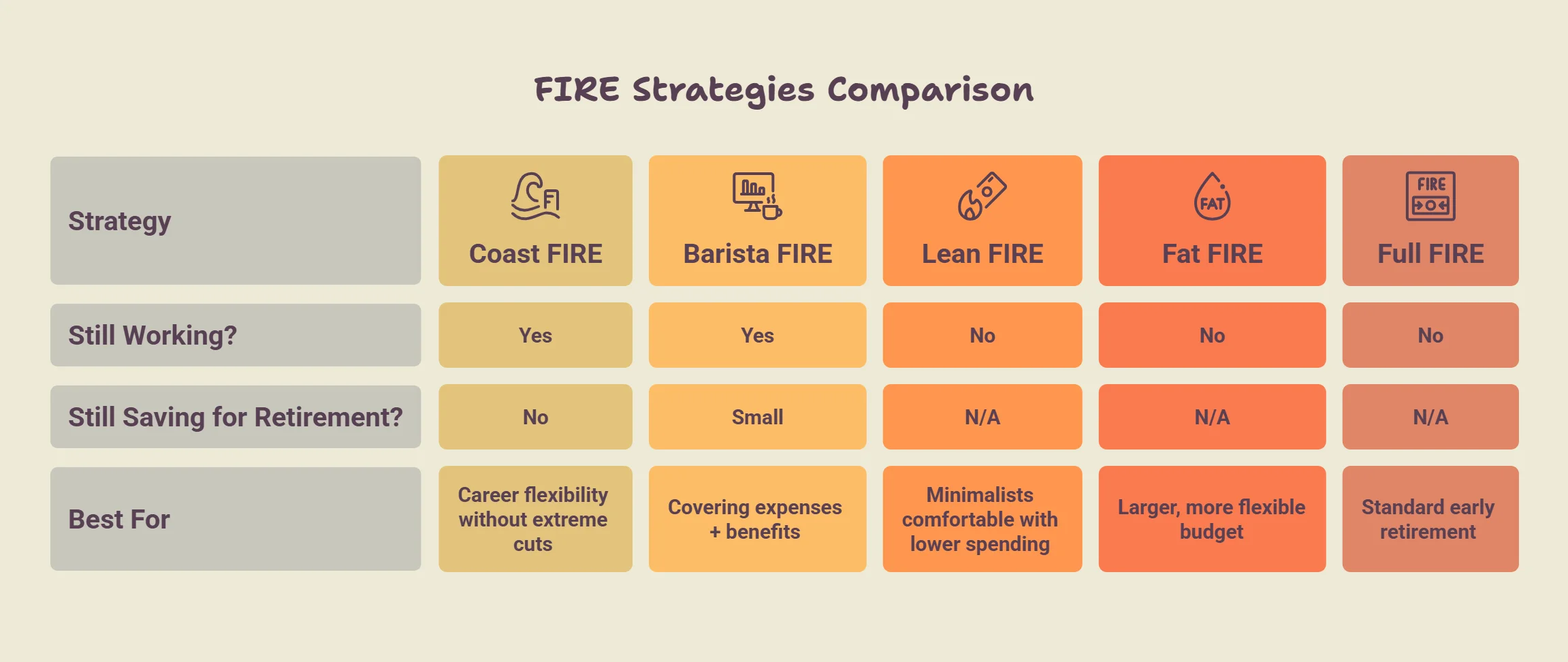
| Strategy | Still Working? | Still Saving for Retirement? | Best For |
|---|---|---|---|
| Coast FIRE | Yes, full or part-time | No (lets investments grow) | Those wanting career flexibility without extreme cuts |
| Barista FIRE | Yes, part-time | Small ongoing contributions | Covering expenses + benefits (like health insurance) via part-time work |
| Lean FIRE | No | N/A - fully retired | Minimalists comfortable with a lower spending retirement |
| Fat FIRE | No | N/A - fully retired | Those wanting a retirement with a larger, more flexible budget |
| Full FIRE | No | N/A - fully retired | Standard early retirement at a moderate, sustainable spending level |
Coast FIRE stands out because it doesn't require you to quit working. It simply removes the obligation to keep funding your retirement accounts, which makes it one of the more achievable and lower-risk FIRE variations.
Sample Coast Fire Numbers by Age
To make the math feel more concrete, here's what a Coast FIRE number might look like at different starting ages, assuming a $1,500,000 retirement goal, retirement at 65, and a 7% average annual return.
| Current Age | Years to Grow | Approximate Coast FIRE Number |
|---|---|---|
| 25 | 40 | $79,700 |
| 30 | 35 | $138,300 |
| 35 | 30 | $196,900 |
| 40 | 25 | $274,600 |
| 45 | 20 | $387,500 |
| 50 | 15 | $543,600 |
Key takeaway: Starting just five years earlier can lower your required Coast FIRE number by tens of thousands of dollars, thanks to the extra time compound growth has to work.
Building Your Coast Fire Action Plan
A calculator gives you a number - but turning that number into reality takes a plan. Here's a practical framework to follow.
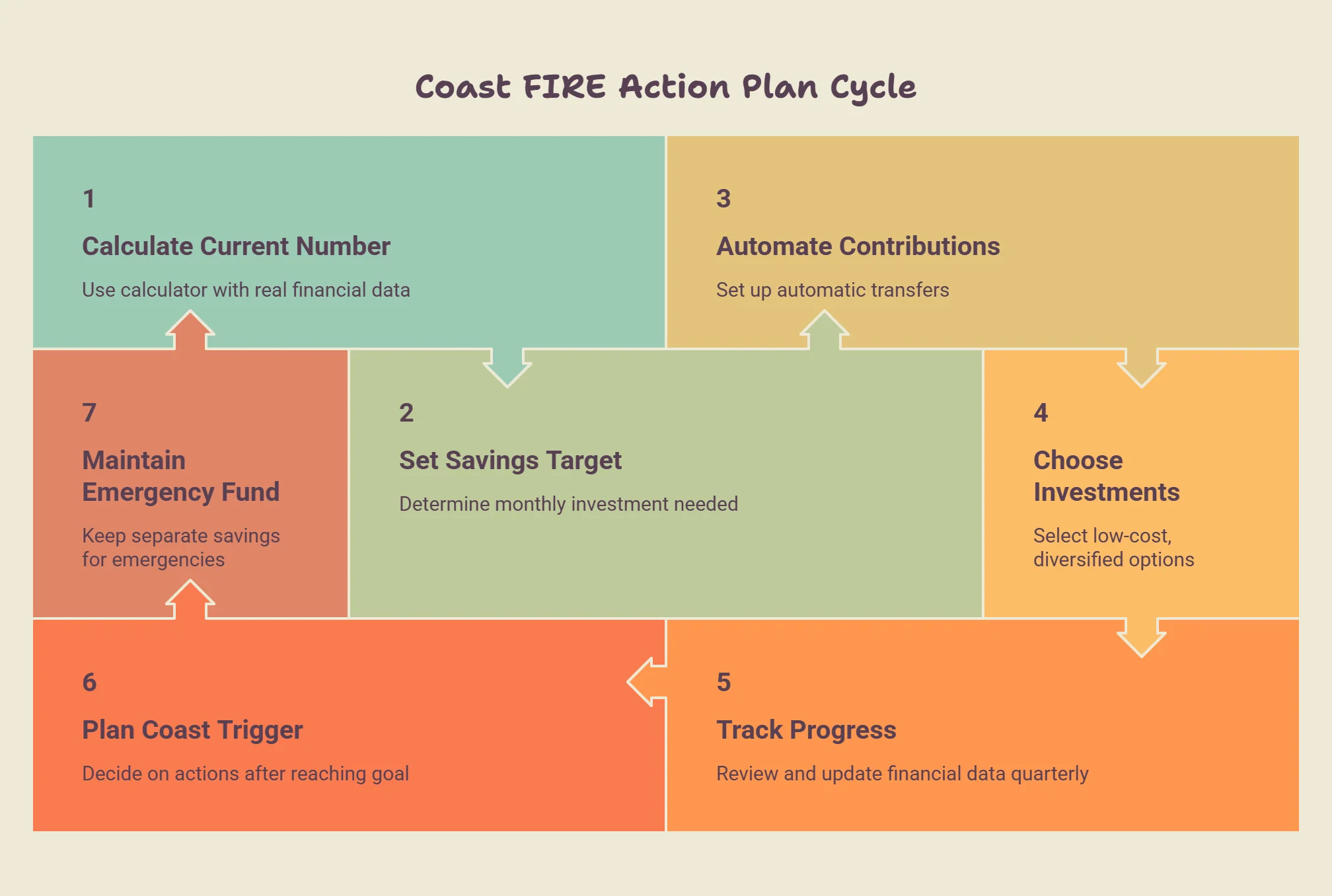
- Calculate your current number. Use a coast fire calculator with your real income, expenses, and current invested balance.
- Set a savings rate target. Reverse-engineer how much you need to invest monthly to hit your Coast FIRE number within your desired timeframe.
- Automate your contributions. Set up automatic transfers to your 401(k), IRA, or brokerage account so investing happens consistently, without relying on willpower.
- Choose low-cost, diversified investments. Broad index funds or target-date funds are commonly used for their long-term growth potential and low fees.
- Track your progress quarterly. Revisit your calculator inputs every few months, especially after raises, bonuses, or major expense changes.
- Plan your “coast trigger.” Decide in advance what you'll do once you hit your number - reduce hours, switch careers, or simply enjoy less financial pressure at your current job.
- Keep an emergency fund separate. Your Coast FIRE number should reflect invested retirement assets only - not your emergency savings or short-term cash reserves.
FAQs
What is a coast fire calculator?
A coast fire calculator is a financial planning tool that estimates how much you need to invest today so your money grows, untouched, into your full retirement goal by your target retirement age.
How to calculate my coast fire number?
Divide your target retirement portfolio (often 25x your annual expenses) by (1 + your expected annual return) raised to the power of the years remaining until retirement. This tells you the amount needed to be invested today.
Why does compound growth matter for Coast FIRE?
Compound growth is the entire mechanism behind Coast FIRE. Once you reach your number, your investments grow exponentially over time, allowing you to stop contributing while still reaching your retirement goal on schedule.
When should I start using a coast fire retirement calculator?
The earlier, the better. Starting in your 20s or early 30s gives your investments more time to compound, meaning you'll need a smaller invested amount today to reach the same future goal.
Which is better: Coast FIRE or full FIRE?
Neither is universally "better" - it depends on your goals. Full FIRE means retiring completely early, while Coast FIRE offers more flexibility, letting you reduce work stress or income while still reaching financial independence by traditional retirement age.
Should I include Social Security in my coast fire calculator inputs?
Most planners leave Social Security out of the core calculation to build in a safety margin, since future benefit amounts and eligibility rules aren't guaranteed. If you have a stable pension, it's reasonable to subtract expected pension income from your annual retirement expenses instead.
Is "coastFI" the same as "Coast FIRE"?
Yes. "CoastFI" and "Coast FIRE" refer to the same concept and are used interchangeably. Some prefer "coastFI" since the strategy involves continuing to work rather than retiring early in the traditional FIRE sense.
Conclusion
Coast FIRE offers a realistic approach to financial independence that doesn't require a lot of sacrifice or a sudden departure from work. With a Coast FIRE calculator, you will be able to determine the amount you'll need to invest now to allow compound growth to take you all the way, regardless of whether looking to do it alone or employing a calculator for coast fire couples to set goals with your partner.
The earlier you determine the Coast FIRE figure, the quicker you will be able to make educated decisions about your job as well as your savings rate and even your lifestyle. Begin to calculate your numbers now and revisit them every year and eliminate the decision-making off of your retirement planning.
Are you ready to find your Coast FIRE number? Enter your information into the calculator above to see how you're on your way to cruising towards retirement.
Disclaimer: This page is educational content, not personalised financial advice. Projections use constant returns and ignore taxes, fees and sequence-of-returns risk unless stated. Consider speaking to a regulated financial adviser before making retirement decisions.